The purpose of Made-in-D is to create a label on products that fulfill several key requirements:
•The product is DESIGNED and DEVELOPED in democracies.
•The product is ASSEMBLED in a democratic country.
•90% or more of the value of the Bill of Materials (BOM) comes from democratic countries.
•The manufacturer has self-certified the above using our standardized software.
•The manufacturer agrees that a certifying organization may supervise and audit the certified product worldwide to make sure standards are upheld.
Functionality of self-certification for a product.
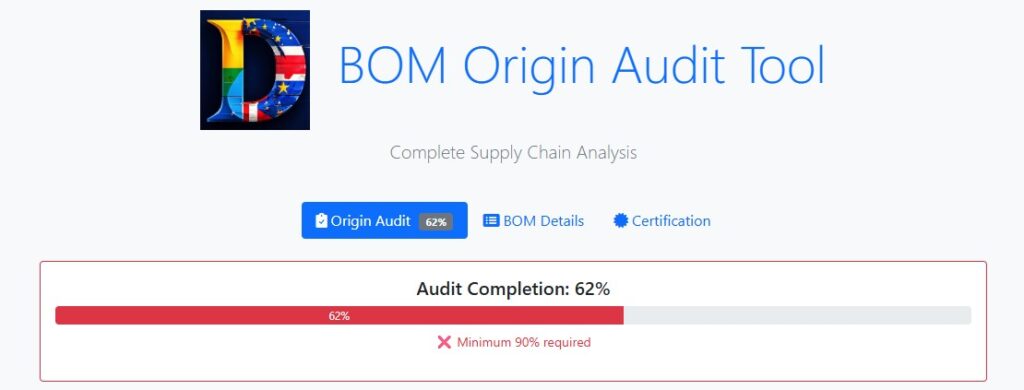
•Download a simple software that guides the company through self-certification.
•The software audits where the design, development and assembly of a product are done.
•The software documents the BOM of sub-assemblies and the corresponding value as a % of total.
•The software gives feedback on if the product would qualify as “Made-in-D” or not.
•A detailed report is stored locally which contains confidential information such as vendors and pricing. The report is stored locally but not sent to parties outside of the certifying company.
•A less detailed report with no proprietary information is generated, which can be submitted to the Made-in-D certifying body for the Made-in-D certification for the product of interest.
•Sensitive information on pricing, vendors and development is stored on local company servers and normally not made available to Made-in-D, unless the product is audited.
Why is self-certification the preferred method?
•It uses the principle of trust and verify, or the belief that most companies that will invest the resources needed for certification would do so on a good-faith basis.
•It allows the companies to maintain proprietary information, such as name of suppliers on a local network, limiting potential for information reaching competitors.
•Encourages acceptance by companies as it presents very low costs and risks and important potential sales and marketing benefits.
•Limits costs and need for assistance, thus only small regional teams would be setup for verifications and some IT support.
•It allows limiting costs in early phases of certification acceptance, as the brand grows, allowing to scale up quickly and with lower costs.
An a-political structure of PRODUCT certification authority is essential to its success.
•Countries must be split into democratic or non-democratic, this can be challenging given many intermediate shades of democracies.
•List of countries that qualify as democratic is compiled based on a composite of already existing reports from 3rd party organizations (e.g. Economist Democracy Index ).
•Initially the list would be 100% objective criteria based on above classifications and standardized rules (e.g. 3 of 4 entities must certify a given country as democracy).
•As the list of democracies is based on objective rules and other certification bodies, the certificating entity is neutral. This would allow the certification entity (D-for-Democracy) to be shielded from political pressure.
•Ideally, as the organization grows, the external board would be of recognized figures who would be immune from political pressure and would promote the organization.